by First Integrity Team Supreme Lending | May 10, 2025
Don’t let these condo loan myths get in your way of homeownership!

Condominiums can be an appealing alternative to traditional homes, offering perks like lower maintenance, community features, and prime locations. However, some potential homebuyers may hesitate to pursue applying for a condo loan, often due to misconceptions that it’s more challenging to secure a mortgage than a single-family home.
While getting a condo loan involves a few additional considerations, it isn’t as daunting as it may seem. With the right lender on your side, you can move through the process smoothly and confidently. At Supreme Lending, our dedicated condo team specializes in handling all the details. This will ensure your loan process is seamless from start to finish.
How Condo Financing Differs
When you apply for a mortgage on a single-family home, the lender’s primary focus is on your financing qualifications and the property itself. Condo financing, on the other hand, involves an additional layer of approval—not just on the individual unit but the overall condo complex. Lenders will review factors including:
- Homeowners Association (HOA). The financial health of the condo association and the condition of the property are evaluated to ensure the community is well-managed.
- Occupancy Rates. Lenders may require a certain percentage of units to be owner-occupied to reduce potential risks associated with high rental occupancy.
- Legal Status. The lender will also ensure there are no legal issues or disputes involving the condo association that may impact the financing process.
- Insurance Coverage. There are specific insurance requirements for the building and the association, which lenders review as part of the approval process.
These steps may add some complexity but are designed to protect both the buyer and lender. Now let’s debunk these common condo loan myths.
Myth #1 – Condo Loans Are Too Complicated
Condo loans may involve a few more steps than financing a single-family home, however they’re not as complicated as you might think. When you apply, you’ll provide basic details about the condo property, including the address. Then our specialized team at Supreme Lending will take it from there to review the complex. In some cases, you may even qualify for a limited review, which requires less paperwork and verification.
Myth #2 – Condo Underwriting Takes Took Long
The underwriting for a condo loan involves reviewing the financials, insurance, and rules of the condo’s Homeowners Association (HOA) to ensure the property is solid. While it may seem like more work, Supreme Lending’s condo team is quick to keep the process moving, helping to avoid any delays and keeping things on track.
Myth #3 – Condo Financing Is Riskier for Buyers
Some homebuyers may worry that getting a condo loan is riskier than financing a traditional home because of the HOA and shared ownership. In reality, the detailed review process can give buyers peace of mind that their condo community is financially stable and well-managed, so much so that their lender approved the condo loan.
Ready to Finance Your Dream Condo?
We’re here to help! There’s a reason why Supreme Lending offers such a wide variety of loan programs, including condo financing. Don’t let these condo loan myths hold you back. Contact us to get started today.
Related Articles:
by SupremeLending | Jul 26, 2024

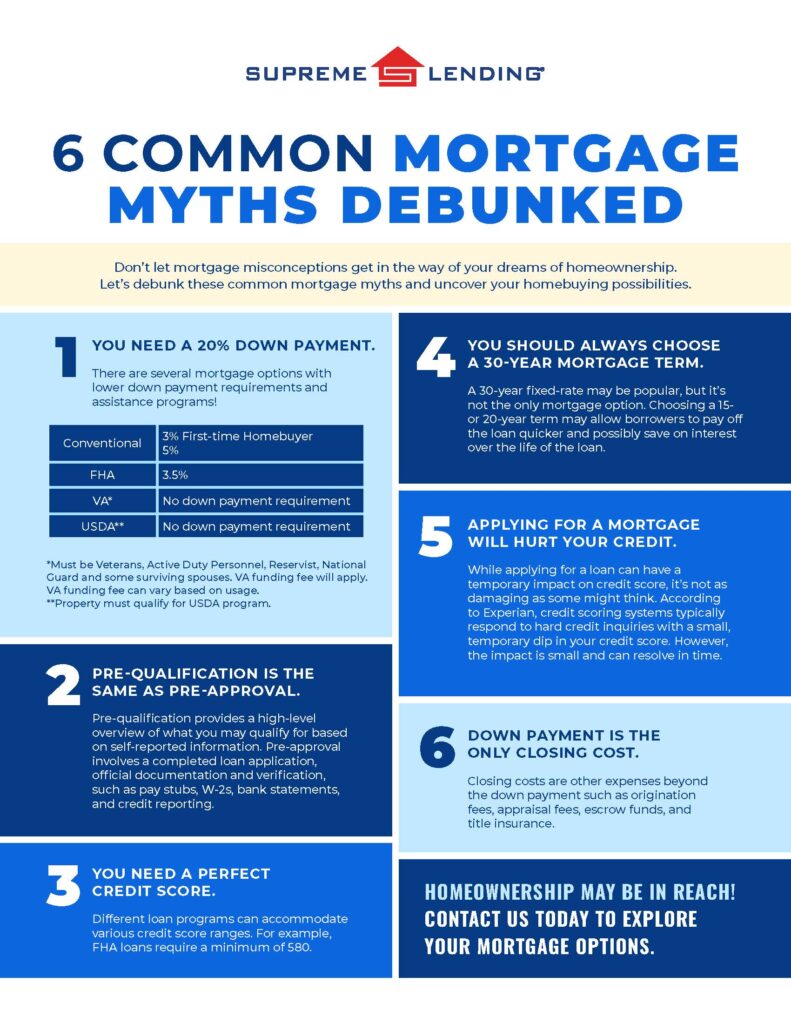
Don’t let mortgage myths get in the way of your dreams of homeownership. Unfortunately, there are several misconceptions about home financing that can make getting approved for a loan seem more difficult than it could be. Supreme Lending is here to set the record straight and help you navigate the steps of the mortgage process with the knowledge you need. Let’s debunk these six common mortgage myths and uncover your homebuying possibilities.
#1 Myth: You Need a 20% Down Payment.
Believing that you must have at least a 20% down payment saved up for a home may be one of the most common mortgage myths of all. When in fact, there are several loan options with lower down payment requirements.
For example, Conventional loans can require as low as 3% down for first-time homebuyers and 5% for repeat buyers. FHA loans require 3.5% down, serving as another affordable option. VA* and USDA** loans are unique in that they require zero down payment. There are also several down payment assistance programs for eligible homebuyers depending on various factors such as income or geographic location.
Why 20% Down?
The 20% myth may be misunderstood because of private mortgage insurance (PMI). If you don’t put down 20% for a Conventional loan, lenders will typically require you to have PMI, which is an added cost to your monthly mortgage payment. It’s important to note that if a borrower reaches a specified equity threshold in their home, mortgage insurance may be removed.
#2 Myth: Pre-Qualification Is the Same as Pre-Approval.
Nope. These terms are often used interchangeably but they are not the same when it comes to where you are in the loan process. Both provide an estimate of how much you may be able to afford for your monthly mortgage payments. However, the key difference between a mortgage pre-qualification and pre-approval is how lenders verify your information.
Pre-qualification is a high-level mortgage estimate based on self-reported information, such as income, debts, and assets. Plus, it’s oftentimes quicker to obtain.
On the other hand, a pre-approval takes a more detailed approach. This involves a completed loan application. Homebuyers must provide thorough documentation of financial history such as pay stubs, W-2s, and bank statements for verification. To get pre-approved, lenders will also verify your credit and employment.
#3 Myth: You Need a Perfect Credit Score.
A recent study found that people either don’t know or significantly overestimate the minimum credit score required for a typical mortgage, reported by Mortgage Professional America. While a higher credit score may help you secure more favorable mortgage rates or qualify for a higher loan amount, you don’t need to have flawless credit.
Different loan programs can accommodate various credit score ranges. For example, FHA loans are designed to make homeownership more accessible by accepting lower credit scores, a minimum requirement of 580.
#4 Myth: You Should Always Choose a 30-Year Mortgage Term.
A 30-year fixed-rate may be one of the most popular mortgages, but it’s not the only one to choose from. Depending on your situation or long-term goals, other mortgage terms may be a better fit. Whether it’s a 15-year term to pay the loan off quicker, or a 20-year term, Supreme Lending offers a wide range of options that can be tailored to match your needs.
#5 Myth: Applying for a Mortgage Will Hurt Your Credit.
While applying for a loan can have a temporary impact on your credit score, it’s not as damaging as some might think. When you apply for a new loan, lenders will pull your credit. This is also known has a hard inquiry for your credit report. According to Experian, credit scoring systems typically respond to hard credit inquiries with a slight, temporary dip in your credit score by a few points. However, the impact is small and can resolve in time.
Additionally, once approved for a mortgage, making on-time monthly payments may strengthen your credit in the long run.
#6 Myth: Down Payment Is the Only Closing Cost.
The down payment is a key part of closing a loan but isn’t the only cash you need to finalize your mortgage. Closing costs are other expenses beyond the down payment such as origination fees, appraisal fees, escrow funds, and title insurance. These costs will be outlined in the closing disclosure.
In addition, some lender programs allow borrowers to buy discount points to reduce their interest rate. This is essentially buying down the rate to save in interest over time. One discount point would equal 1% of the loan amount and would be included as a closing cost.
Understanding the Mortgage Process
Buying a home is one of the most significant purchases you can make. It’s crucial you’re properly informed about the loan process. By debunking these common mortgage myths, we hope to empower you with the knowledge needed to make informed decisions.
At Supreme Lending, we’re dedicated to providing personalized service and expert guidance throughout your homebuying journey. If you have any questions or want to explore your mortgage options, contact us today!
*Must be eligible Veterans, Active Duty Personnel, Reservist, National Guard, or qualifying surviving spouses. VA funding fee will apply. VA funding fee can vary based on usage.
**Property must qualify for USDA program.