by First Integrity Team Supreme Lending | Aug 14, 2024

There are several things to consider when deciding to refinance* your mortgage. It’s essential that you’re well-informed and ready to make an educated home financing decision to reach your goals. Once you’ve established how soon you can refinance, here are seven other important considerations.
1. Home Equity: The Foundation of Refinancing
One of the first things to evaluate when deciding to refinance your mortgage is how much equity you have built in your home. Equity is the portion of the property that you truly “own”—the value of your home minus your mortgage debt. Typically, lenders require that you have at least 20% equity in your home to qualify for a refinance. If you haven’t built up sufficient equity, you may not be eligible or you may receive less favorable terms. Your home equity is especially important when considering cash-out refi loans.
2. Credit Score: Your Financial Passport
Your credit score is crucial when it comes to your mortgage and loan program requirements. Your credit reflects your financial history. It also helps lenders determine a borrower’s potential risk. A higher credit score may help you unlock a more favorable mortgage. Before applying for a refinance loan, understand where you stand with your credit. Also, ensure that you’re up to date on making other debt payments.
3. Debt-to-Income (DTI) Ratio: Balancing Your Financial Obligations
Lenders will also review your Debt-to-Income (DTI), which is the ratio percentage of your monthly income that goes toward paying debts. A lower DTI ratio can demonstrate to lenders that you’re capable of managing your current debts and have the ability to repay your mortgage. Generally, a DTI of 43% or less is preferred but some loan programs and lenders can be more flexible and accept higher ratios.
4. Closing Costs: The Price of Change
Refinancing isn’t free. Don’t forget about the closing costs and associated fees that come when you refinance your mortgage. These can include application fees, originating fees, appraisals, and more. These expenses can add up to anywhere from 2% to 6% of the loan amount. It’s vital to review these costs to determine if refinancing makes sense for you. A breakdown of refinance closing fees will be included in your mortgage closing disclosure.
5. Break-Even Point: Calculating the Payoff
Understanding your break-even point is essential when you refinance your mortgage. This is the point at which your possible savings from a new loan exceed the costs of refinancing. To calculate this, divide the total cost of refinancing by the potential monthly savings from the new monthly mortgage payment. The result is the number of months it may take to recoup the costs. If you plan to stay in your home past the break-even point, refinancing may be very beneficial.
6. Interest Rates: When Is the Right Time?
Interest rates are also a driving factor when deciding to refinance your mortgage. A general rule of thumb is that refinancing is worth considering if you can reduce your interest rate by at least 0.5% or more. However, every borrower’s situation is different, so it’s important to analyze how a new rate will impact your unique financial picture and monthly mortgage payments. There are other reasons to refinance beyond the interest rate.
7. Private Mortgage Insurance: Can You Remove It?
If you put less than 20% down payment on your initial mortgage, you’re typically required to pay for private mortgage insurance (PMI). This protects lenders in case of a default on the loan. It’s an additional cost to your monthly payments. However, if you have more than 20% equity built in your home, refinancing may help remove the cost of PMI and reduce your payments.
At Supreme Lending, we understand that deciding to refinance your mortgage is a significant step, and you deserve significant service. By carefully weighing these seven considerations, you’ll be in a strong position to make a decision that aligns with your desired outcomes. When you’re ready to discuss your mortgage and refinancing options, our team is here to guide you every step of the way.
*By refinancing an existing loan, total finance charges may be higher over the life of the loan.
by SupremeLending | May 31, 2024
The Ultimate Mortgage DTI Handbook
When it comes to securing a mortgage, understanding your finances has never been more important. One of the most important metrics lenders use when evaluating a borrower’s eligibility for a mortgage is Debt-to-Income ratio, commonly known as DTI. Let’s dive into what exactly mortgage DTI is, how it’s used, what sources of debt and income are considered, and what establishes a fair or good DTI. Plus, we’ll offer some helpful tips for potential homebuyers on understanding their DTI.
What Is Debt-to-Income (DTI) Ratio?
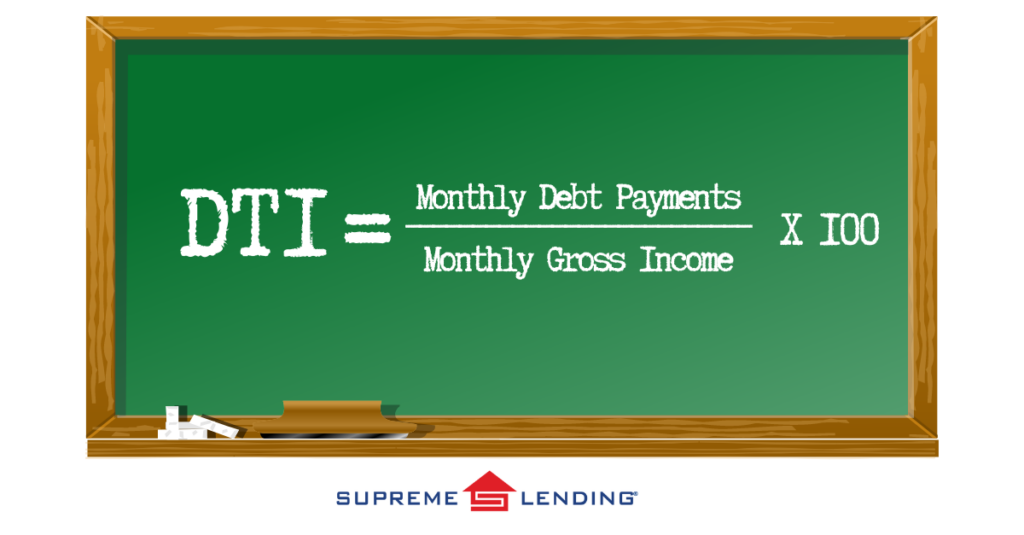
DTI is a financing metric that compares an individual’s monthly debt payments to their gross monthly income. Essentially, it measures the percentage of your income that goes toward paying off debts. Lenders use DTI to assess a borrower’s ability to make monthly payments to repay the loan. DTI is calculated by dividing your total monthly debt payments by your gross monthly income and multiplying the result by 100 to get the ratio percentage.
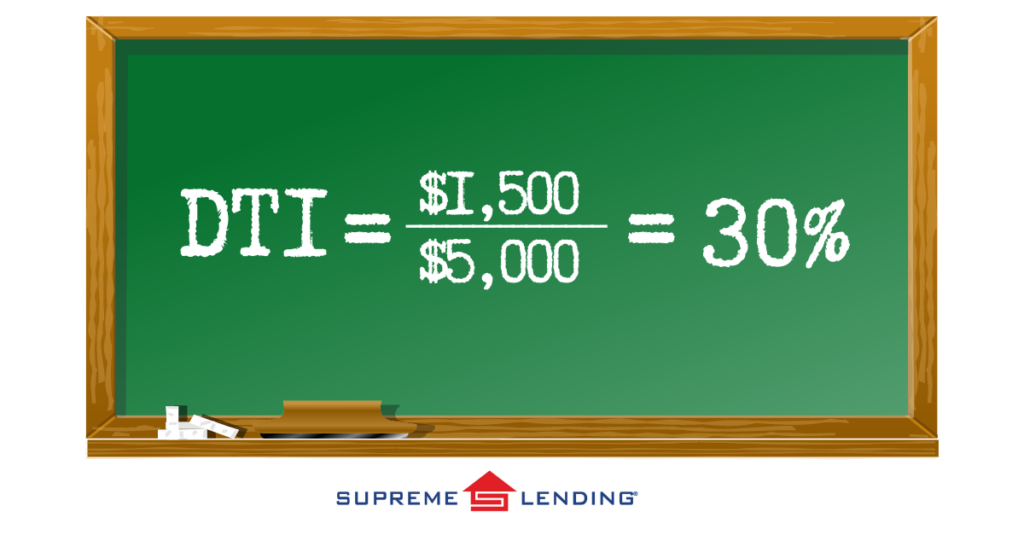
For example, if you have $1,500 in monthly debt payments and a gross monthly income of $5,000, your DTI would be 30%, as calculated below:
How DTI Is Used to Determine Mortgage Eligibility
Lenders look at your DTI to evaluate your ability to take on additional debt in the form of a mortgage. A lower DTI indicates that you have a good balance between debt and income, resulting in a more attractive and capable buyer. There are DTI thresholds that borrowers will need to meet, which can vary by lender or specified by the loan program guidelines.
Types of Mortgage DTI
- Front-end DTI: Also called a housing ratio or mortgage-to-income, this ratio only calculates housing-related expenses, such as the monthly mortgage payment, property taxes, homeowners’ insurance premiums, and homeowners association fees, if applicable, relative to your gross monthly income.
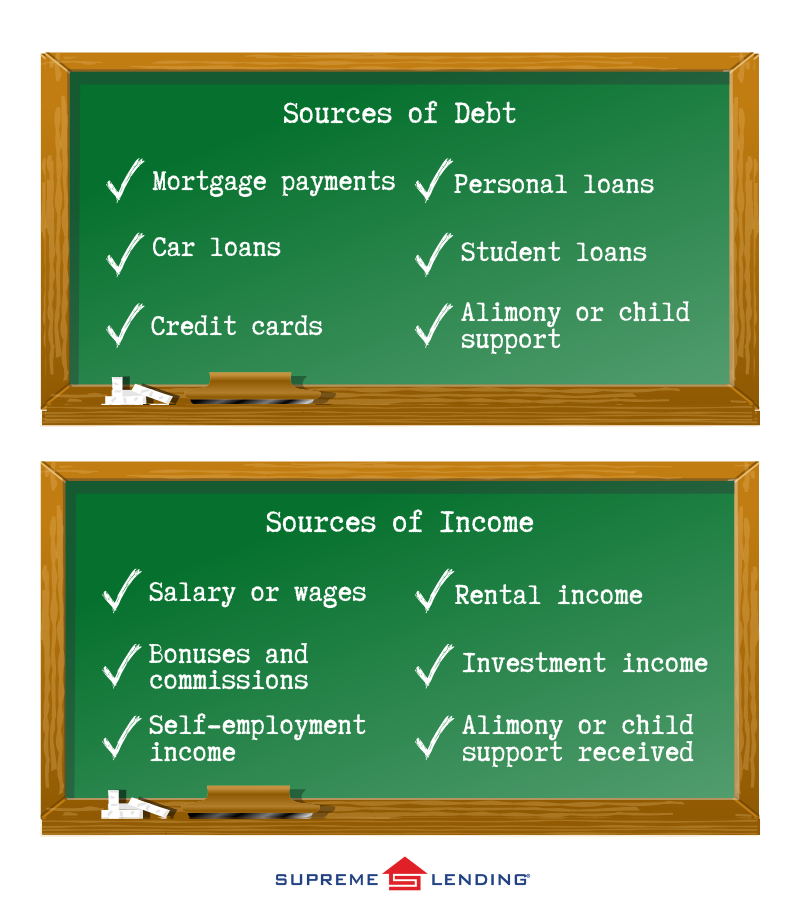
- Back-end DTI: This ratio includes all your monthly debt obligations, such as credit card payments, car loan payments, and student loan debt, in addition to the housing-related debt. Lenders typically focus more on back-end DTI when evaluating a buyer’s capability to repay a loan as it provides a clearer picture of their financial responsibilities.
Sources of Debt and Income Considered
What Is Considered a Favorable DTI?
A good DTI ratio for a mortgage depends on the type of loan and the lender. Most lenders prefer a back-end DTI of around 36% or less, though some may accept higher ratios, especially for borrowers with strong credit scores or significant assets.
Helpful Mortgage DTI Tips for Potential Homebuyers
1. Avoid New Debt
Before applying for a mortgage, calculate your current DTI to give you a rough understanding of where you stand. This will help identify if you need to make any adjustments to potentially improve your DTI ratio before deciding to purchase a home.
2. Reduce Outstanding Debts
Paying down existing debts can significantly improve your DTI. Consider focusing on reducing or eliminating higher interest debts like credit card balances first.
3. Increase Your Income
Look for opportunities to boost your income. This could be through a salary increase, getting a higher-paying job, adding a part-time gig, or exploring other income sources.
4. Avoid New Debt
Refrain from taking on new debt before applying for a mortgage and during the loan approval process. New loans or credit lines may have an impact on your DTI and mortgage eligibility.
5. Seek Professional Advice
Consult with a financial professional for personalized guidance or a loan officer to get a better understanding of your DTI and loan program requirements. There may be other mortgage options better suited for you depending on your goals, such as Debt Service Coverage Ratio (DSCR) loans for investment properties that don’t use DTI.
6. Consider a Co-Signer
If your DTI is in the higher range, you may benefit from having a co-signer who has a higher income or less debt to contribute.
7. Understand Loan Programs
Guidelines and criteria to qualify for a mortgage vary depending on the program and lender. For example, FHA loans typically have more lenient DTI requirements than Conventional loans. Work with our team at Supreme Lending to explore a variety of different mortgage options and find the one best fit for you.
Managing Your Debt-to-Income Ratio
Understanding mortgage DTI and your Debt-to-Income ratio is essential for navigating the loan process. By managing your DTI and making informed decisions, you may potentially improve your mortgage eligibility and chances of securing your dream home.
Contact Supreme Lending to learn more about how we can help you achieve your homeownership goals with confidence.
Related articles:
by SupremeLending | Apr 17, 2024

House hunters who are interested in larger or more expensive homes that could exceed certain conforming loan thresholds may need to consider a Jumbo loan program. If you’re dreaming big in your homebuying journey, discover what exactly a Jumbo loan is, qualification requirements, and helpful considerations when looking into a Jumbo loan option.
What Is a Jumbo Loan?
To understand conforming loans, you first need to understand conforming loans, which have maximum loan amounts set by the Federal Housing Finance Agency (FHFA). The 2024 conforming loan limit in most of the country is $766,550, though this may vary depending on the county in which you’re looking to purchase a property. If a loan amount is larger than this, then it’s considered a Jumbo loan.
The FHFA establishes conforming loan limits to regulate the maximum size of loans that government-sponsored enterprises (GSEs) like Fannie Mae and Freddie Mac can purchase or guarantee. These limits are put in place to ensure stability and liquidity in the mortgage market and to promote affordable homeownership. Because of this, Jumbo loans present a higher risk to lenders and often have different requirements than conforming loans.
For example, down payment requirements for Jumbo loans are typically higher, around 20% or more of the loan amount. They may also require private mortgage insurance (PMI) or carry higher interest rates than conforming loans.
Differences Between Jumbo Loans and Conforming Loans
Let’s go over the direct differences in qualifications and other areas between Jumbo loans and conforming loans:
- Down payment requirements. Jumbo loans tend to have stricter minimum down payment guidelines, often 20% or more of the loan amount. Conforming loans may be as low as 3% for first-time homebuyers.
- Private mortgage insurance (PMI). Jumbo loans almost always require private mortgage insurance, whereas conforming loans typically only require it if the down payment is less than 20%.
- Interest rates. Jumbo loans often come with higher interest rates than conforming loans due to the potential of higher risk involved for lenders.
- Loan limits. The main difference between these two types of loans is the loan limit. If the amount you’re looking to borrow exceeds the FHFA’s limit for your county, it’s a Jumbo loan.
- Closing costs and fees. Finally, closing costs and fees tend to be higher for Jumbo loans than conforming loans because they’re generally more complex and involve more work for the lender.
Jumbo Loan Qualifications Overview
While these conditions can vary somewhat depending on your area and a few other factors, here are some general guidelines for homebuyers looking to qualify for a Jumbo loan:
- Credit score. Credit and related requirements are typically higher for Jumbo loans than Conventional loans. In general, there tends to be a hard credit score minimum of 660, and many lenders may even require as high as 720 or 740.
- Debt-to-income (DTI) ratio. The maximum DTI for a Jumbo loan is typically around 43%, though this can vary depending on the specific lender. This means that no more than 43% of your income should be going towards debts each month.
- Documentation. Jumbo loans typically require extensive documentation, often including tax returns, bank statements, and asset verification. This is to ensure that you’re able to afford and repay the loan and aren’t taking on more debt than you can handle.
- Cash reserves. Another important factor that lenders will look at is your cash reserves. This is the amount of money you have left over after closing on a property that can be used to make mortgage payments if necessary. Lenders typically like to see at least six months’ worth of mortgage payments in cash reserves, though this can vary.
- Appraisals. In certain cases, not just one but two appraisals may be required for a Jumbo loan. This is to ensure that the property is worth at least as much as the loan amount and is yet another way for lenders to protect themselves from taking on too much risk.
As you can see, there’s a lot to think about if you’re looking to apply for a Jumbo mortgage. Make sure you understand all the requirements and are comfortable with any potential risks.
Considerations for Jumbo Loans
Jumbo loans may not be for everyone. There are a few potential reasons why someone may want to opt out of choosing a Jumbo loan and go with another option:
- You may not actually need a Jumbo loan. If you’re interested in a larger home but don’t need to borrow more than the conforming loan limit, it may not make sense to take out a Jumbo loan because you can end up paying more in interest and fees than necessary.
- You don’t qualify. As noted above, the lending criteria for Jumbo loans is typically stricter. If you don’t think you can meet them, it’s probably not worth your time to apply.
- The interest rates are high. Jumbo loan interest rates tend to be higher than conforming loan rates, so if you’re not comfortable with that you may want to look at other options.
Why Go Jumbo?
While there are important factors to consider, Jumbo loans can still be a great option for larger home purchases—especially in high-cost housing markets. Jumbo loans give qualified borrowers access to more expensive properties, including luxury estates, high-end condos, and prestigious neighborhoods. This expands the pool of available housing options, catering to diverse preferences and lifestyles. Additionally, Jumbo loans can often come with customizable terms and features tailored to the unique needs of high-net-worth individuals or savvy investors.
For more information on Jumbo loans, or to learn about any of our mortgage services, contact your local Supreme Lending team today.